
The Guide to Understanding Every Part of a Door
A door looks simple until you’re the one specifying it. Then a contractor mentions a mull, a supplier asks about your rough opening, and you realize a door is really a system of a dozen-plus parts working together. Once you understand how those parts connect, you stop picking a door by looks alone and start understanding why it performs, seals, and ages the way it does, so we’ll help you understand every part of a door for you to have more tools when choosing a door for your home.
This guide breaks the door down into five connected systems: the frame, the panel, the light-and-glass elements, the weatherproofing, and the hardware. We’ll also cover how they’re designed to work together, not just what each part is called.
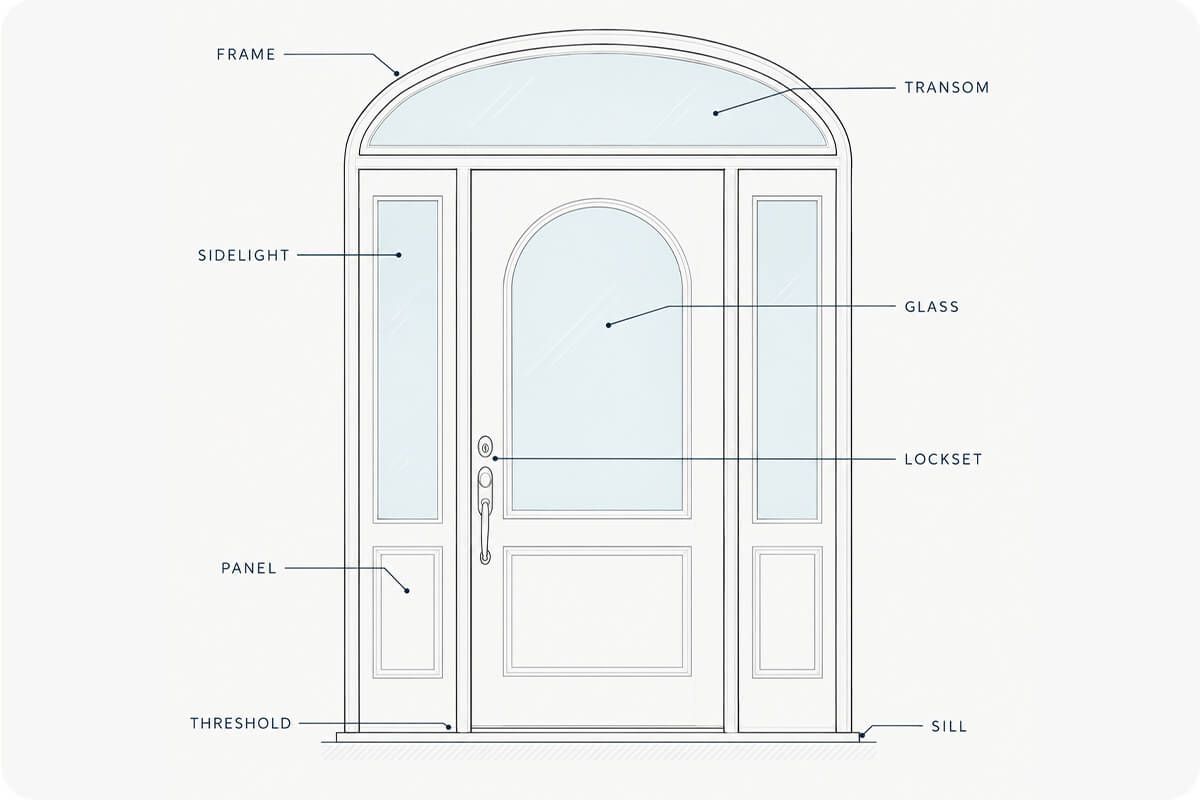
The frame system is what holds a door in place
The frame is the skeleton. It’s what the door panel hangs from and what transfers weight, wind pressure, and daily use into the wall structure. A frame has three core parts:
- Head jamb: The horizontal top piece
- Side jambs: The two vertical pieces
- Sill: The bottom piece, found only on exterior doors, that’s sealed and fastened directly to the floor
On exterior doors, a threshold caps the sill. It’s sloped toward the outside so water sheds away from the house rather than pooling at the base, which is exactly why thresholds are made from metal or fiberglass rather than the same wood as the rest of the frame. Softwood at ground level, exposed to standing water, is a maintenance problem waiting to happen.
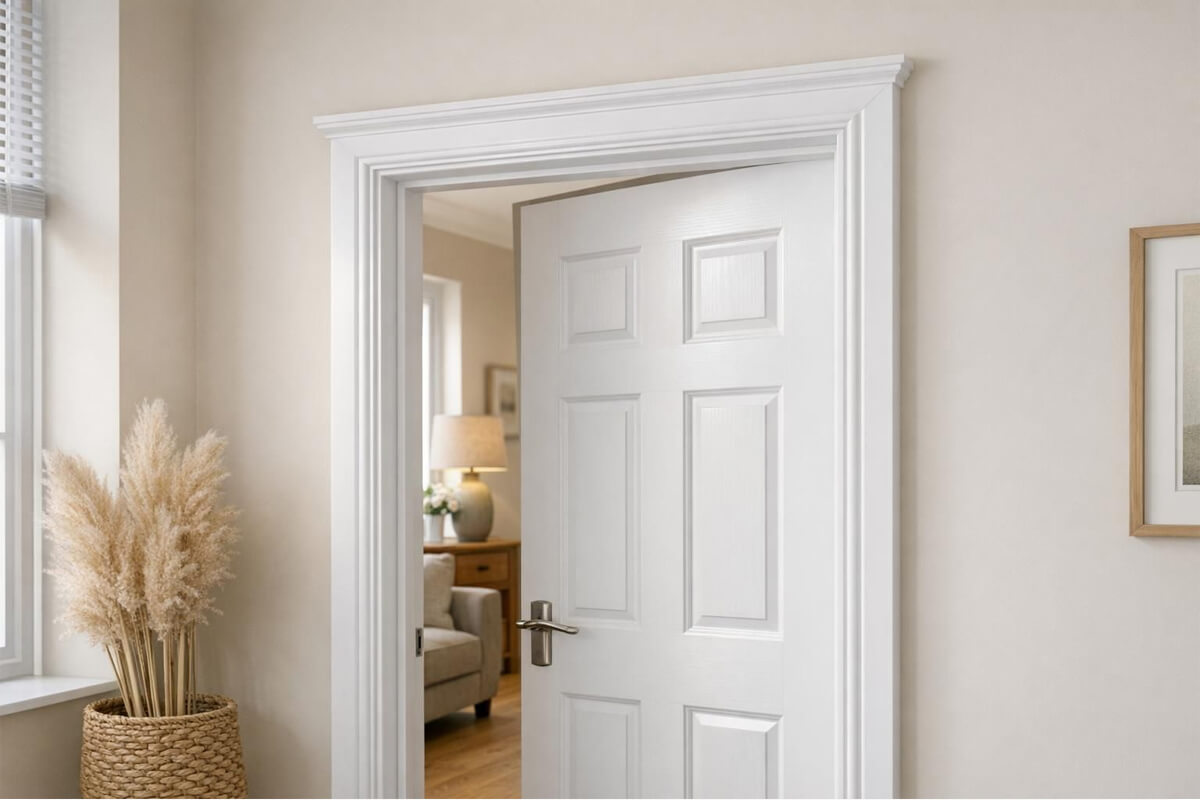
Around the frame, casing (interior) and brickmould (exterior) hide the gap between the frame and the wall. Brickmould is thicker than standard casing for a reason: it has to do double duty as a weatherproof buffer and as the surface a storm door or screen door attaches to.
Why does a door frame need a mullion?
A mullion (often shortened to «mull») is the seam where two framed units join, a door frame to a sidelight, or a door to a transom. It’s a structural connection point, not a decorative one, though it’s usually dressed up with a mull casing so the joint disappears visually. Understanding the mullion is the key to understanding why entry systems with glass look cohesive instead of like three separate units bolted together.
What are the parts of the door panel itself?
The panel (sometimes called the slab) is the part that actually swings. Its structure is built from:
- Stiles: The vertical edges (a hinge stile on one side, a lock stile on the other)
- Rails: The horizontal pieces (top, bottom, and sometimes a mid-rail)
- Panels: The infill pieces set between stiles and rails, which can be solid wood, glass, or a composite core
This stile-and-rail frame is what gives a door its dimensional stability. A solid slab of wood that size would expand, contract, and warp with humidity; breaking it into a frame with floating panels lets each piece move independently, which is why panel doors have outlasted slab-style wood doors for centuries.
Why do doors have sidelights and transoms?
This is where design and function genuinely overlap, and it’s the question homeowners ask most.
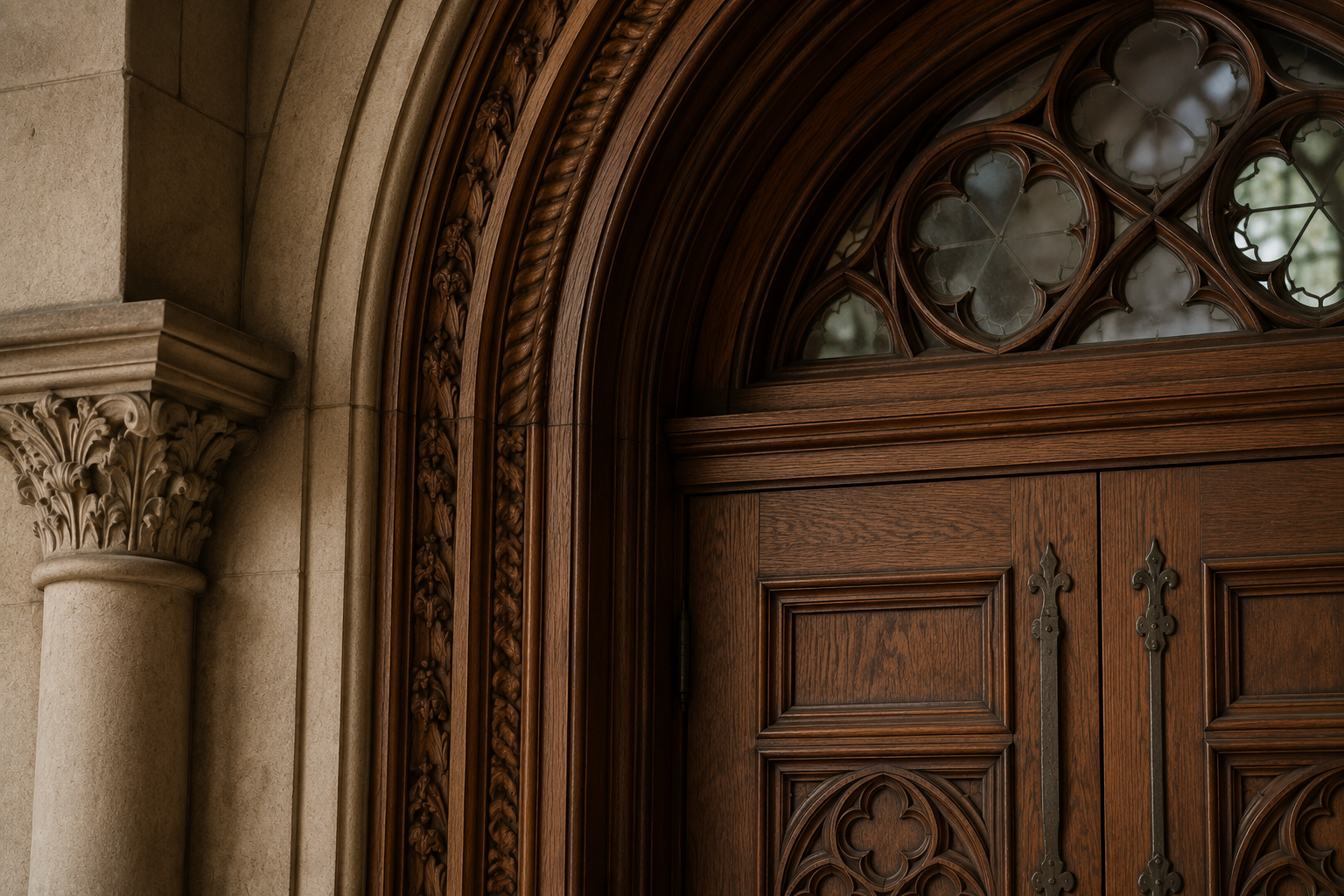
Sidelights are the tall, narrow windows flanking a door. Transoms sit above it.
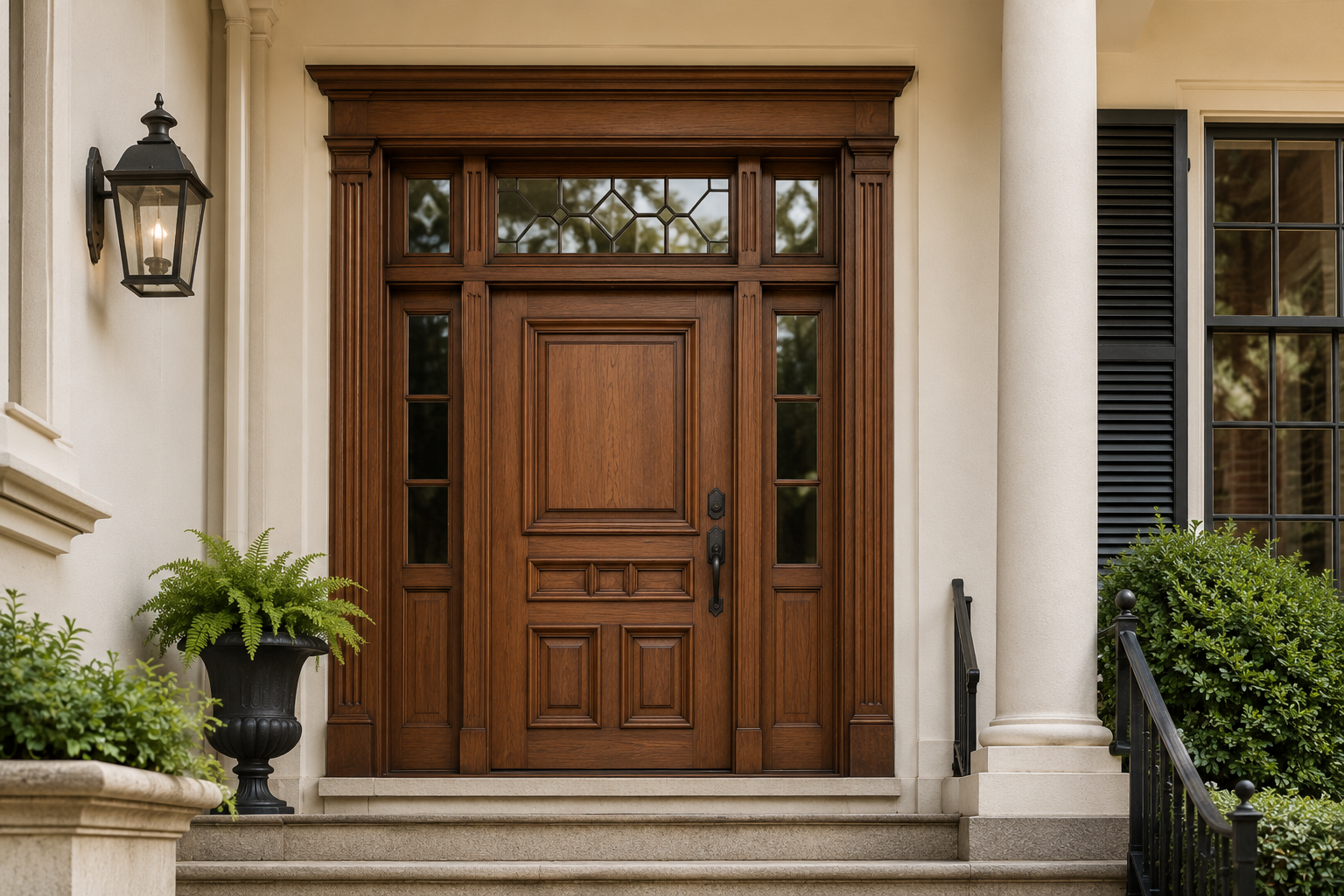
Individually, each adds glazed area near the entry; together, they solve a problem a single door panel can’t: entries are often the darkest part of a house, tucked under a porch roof or facing away from direct sun. A transom brings light in from above, where roof overhangs don’t block it. Sidelights bring it in at eye level, which also improves sightlines, you can actually see who’s at the door before opening it.
The two complement each other because they cover different portions of the wall opening without competing for the same visual space. A wide transom with no sidelights reads as a single strong horizontal line above the door; add sidelights and the whole composition becomes vertical and formal, which is why you’ll see that pairing most often on center-hall colonials and larger entries, while a transom alone suits a simpler or more modern facade.
Inside the glazing itself, grilles or simulated divided lite (SDL) bars create the look of individually paned glass without the maintenance of true divided lites, a nod to a historic style that’s easier to clean and better insulated than the muntin-bar originals.
Have a project in mind?
Talk to us about custom doors and millwork for your home, business, or institution.
What keeps weather and air out of a door?
This is the system most homeowners never think about until it fails. It works in three layers:
| Element | Location | What It Does |
|---|---|---|
| Weatherstripping | Around the door panel's perimeter | Seals the gap between panel and frame |
| Door sweep | Bottom edge of the panel | Seals the gap between panel and threshold |
| Astragal | Between two panels on a double door | Seals the seam where the panels meet |
Each one covers a gap the others can’t reach. Leave any one out and you’ve left a direct path for drafts, water, and, in a climate like Missouri’s with real freeze-thaw swings and humid summers, condensation that can work into the frame over time.
This is also why an old, sagging door often «just» needs new weatherstripping and a sweep rather than a full replacement, the frame and panel can be structurally sound while the seals have simply worn out.

What do hinges, locksets, and strike plates actually do?
The hardware layer is what makes a door usable and secure:
- Hinges connect the panel to the frame and carry its full weight every time it swings, which is why heavier slabs (solid wood, oversized glass doors) need four hinges instead of the standard three.
- Lockset is the umbrella term for the handle, latch, and locking mechanism together.
- Latch retracts when the handle turns, letting the door open; a deadbolt is a separate, more robust bolt that doesn’t rely on the handle mechanism at all, which is why it needs its own bore hole.
- Strike plate and mortise plate sit in the jamb opposite the latch and deadbolt. They’re the piece that actually resists a forced entry attempt; a weak strike plate undermines an otherwise strong deadbolt.
- Escutcheon is the decorative plate around a cylinder or thumb turn, protecting the wood or fiberglass surface from wear.
How the parts work as a system
None of these elements are chosen in isolation on a well-designed door. The frame material affects how the weatherstripping seals. The slab’s weight determines the hinge count. Adding sidelights changes the mullion layout and the overall proportions of the opening.
That’s the real value of knowing this vocabulary: it lets you evaluate a door as a system, one where the frame, the glazing, the seals, and the hardware are all sized and specified to work together, rather than judging it on the finish coat alone.
FAQs: Door Parts and Design
What's the difference between a door jamb and a door frame?
A jamb is one piece of the frame, specifically, one of the two vertical sides. The frame is the complete assembly: both side jambs plus the head jamb on top (and the sill, on exterior doors). People use the terms interchangeably, but a jamb is technically a component of the frame, not a synonym for it.
Do I need both a sidelight and a transom, or just one?
It depends on the scale of the entry and the light you’re trying to add. A transom alone works well on a simpler or more modern facade and adds light from above without changing the door’s footprint. Sidelights alone widen the entry visually and bring light in at eye level. The two together are best suited to larger, more formal entries where the combined height and width can support the added glazing without overwhelming the door.
Why does my door still draft even though it has weatherstripping?
Weatherstripping only seals the perimeter of the panel against the frame, it doesn’t cover the bottom gap (that’s the door sweep’s job) or, on a double door, the seam between the two panels (the astragal’s job). A draft usually means one of those other two seals has worn out or was never installed, not that the weatherstripping itself failed.
Is a mullion just decorative, or does it do something structural?
It’s structural first. A mullion is the actual seam where two framed units, a door and a sidelight, for example, are physically joined. The trim piece covering that seam (the mull casing) is decorative, but the mullion underneath it is doing real structural work holding the units together.
What's the difference between a lockset, a latch, and a deadbolt?
Lockset is the umbrella term for the whole handle-and-locking assembly. The latch is the part that retracts when you turn the handle, letting the door swing open on everyday use. The deadbolt is a separate, heavier bolt operated independently, usually by a key or thumb turn, that doesn’t rely on the handle mechanism at all, which is why it needs its own bore hole and offers a meaningfully higher level of security.
Why do some doors have four hinges instead of three?
Hinges carry the full weight of the panel every time it swings, so heavier doors need more support. Standard-weight interior doors typically use three hinges; solid wood exterior doors, oversized doors, or doors with heavy glass often need four or more to prevent sagging over time.
Contact Our Team!