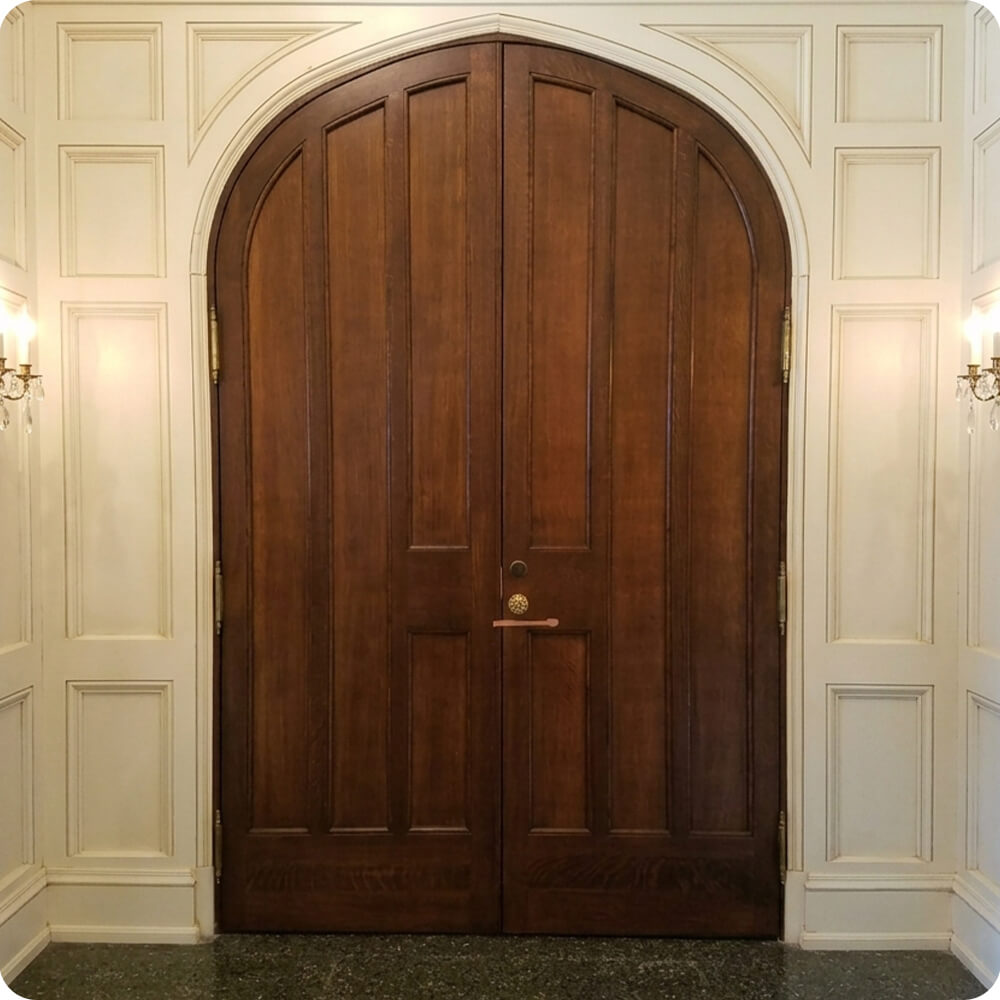
The original entry was a handsome but closed-off pair: arch-top quartersawn oak doors with tall vertical panels and no glass at all. From inside, the vestibule depended entirely on its wall sconces for light, even at midday. There was no way to see who was on the step without opening the door. The hardware had also drifted over the years into a mismatched set: a brass knob, a separate deadbolt, and a plate that matched neither. The doors had real presence, but they made the entry feel like a room with the lights off.
Project Story
The thinking behind the work
The Starting Point
The Thinking
The goal was to open the entry to daylight without giving up privacy or the home's traditional character. That meant glass, but textured glass, so the vestibule would fill with light while the view from the street stayed soft. The old door's defining feature was its arch, and rather than lose that entirely, the design moved the arch into the glass. Each leaf's upper lites carry arched heads, so the curve survives as a detail instead of a silhouette. A single raised panel below grounds the door and keeps the lower half solid where it takes the most wear.
The Execution
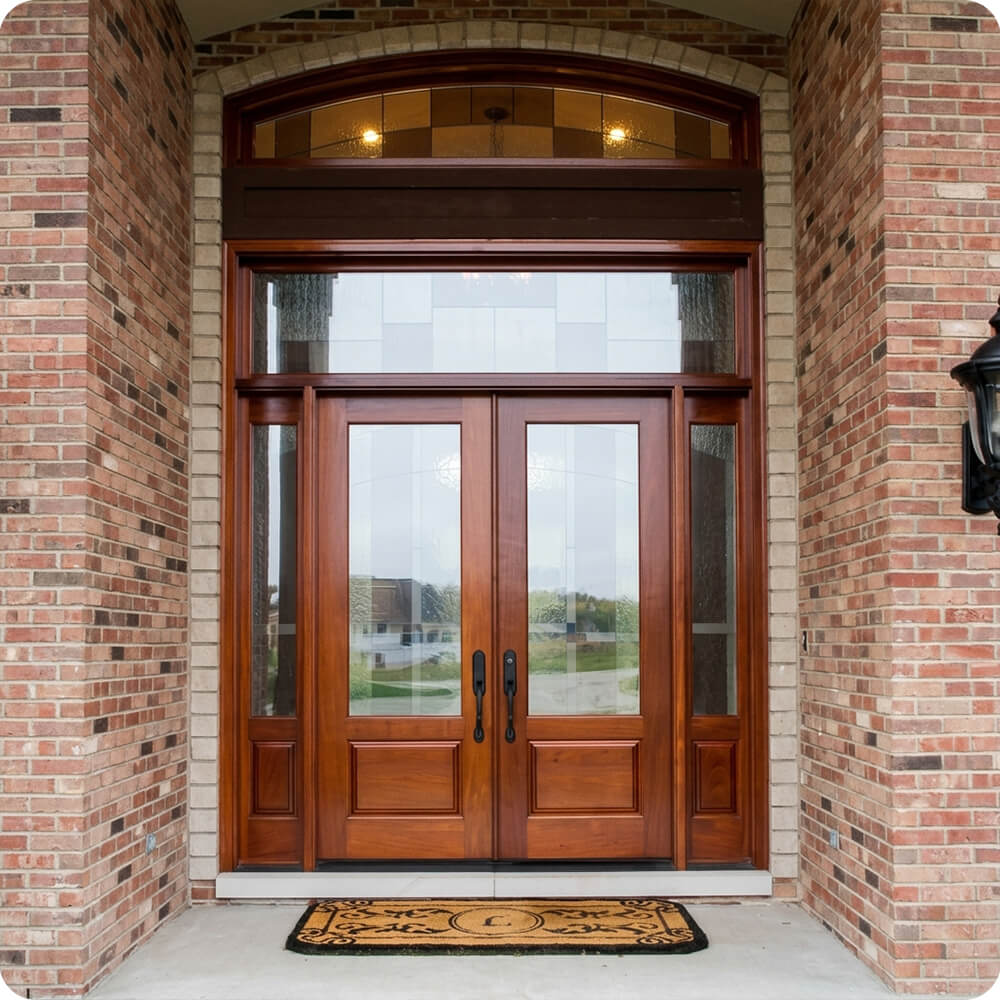
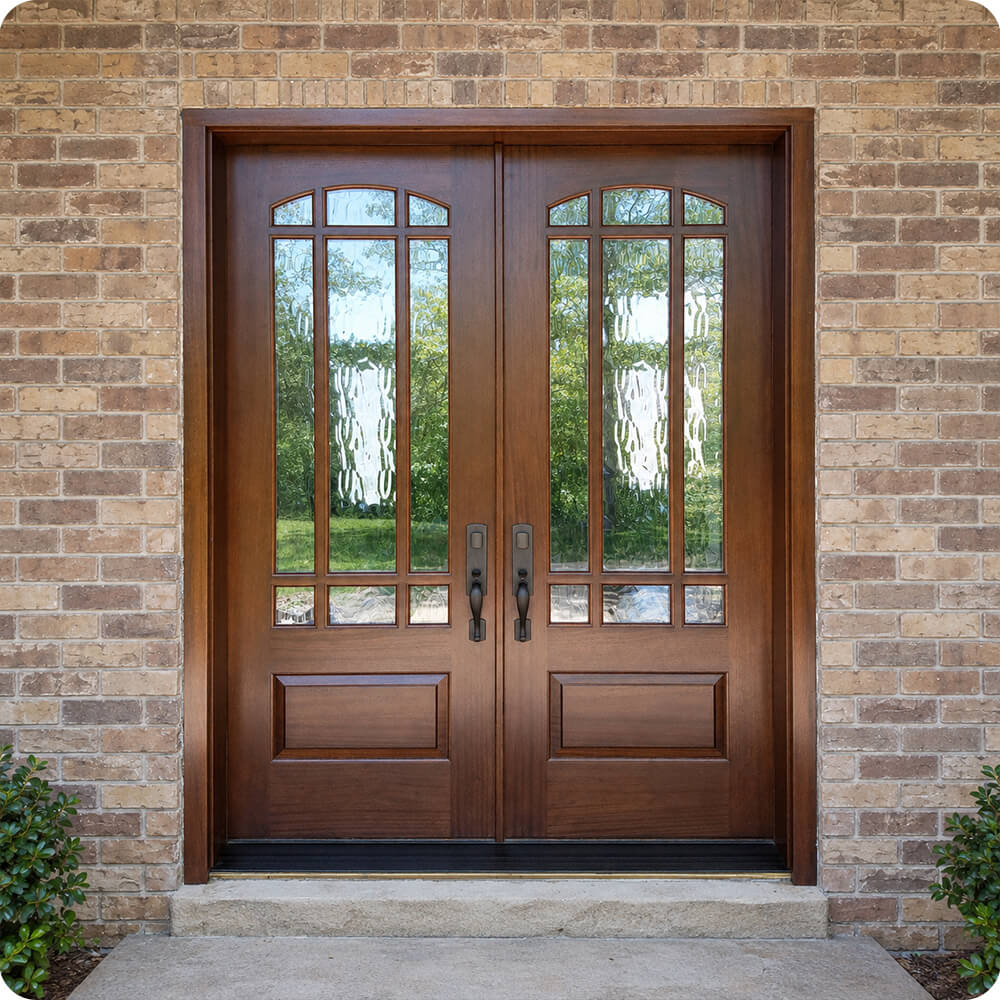
The new pair is built in mahogany with a warm, mid-tone stain that brings out the grain. Each leaf carries nine lites of textured glass: a row of arched-head lites at the top, three tall lites through the center, and a short row below. A single raised panel fills the bottom of each leaf. The doors sit in a matching stained jamb and brick mould set into the masonry opening, over a dark bronze threshold. Dark bronze handlesets with thumb-latch grips replace the mismatched hardware, one on each leaf, giving the pair a symmetrical face from the street.
The Result
The entry now does both jobs the old one couldn't. Daylight pours through eighteen lites into a vestibule that used to need its sconces switched on, and the textured glass turns the view outside into shifting shapes of green rather than a clear line of sight in. The arch is still part of the door, now carried in the glass. Against the brick, the rich mahogany and dark bronze give the house a front door that looks settled and permanent, as if it had always been there.
Specification
Unit Size
6'-4" × 8'-0"
Panel Thickness
1¾"
Joinery
Mortise-and-tenon, no mechanical fasteners.
Glass
Clear glass, 6-lite arched grid per leaf over two raised panels below
Finish System
Multi-coat stain with exterior clear topcoat
Hardware
Dark bronze handlesets with thumb-latch grips, both leaves
Installed By
Scobis
Common Questions
Why replace a solid door with glass?
A solid entry pair leaves the space behind it dark and gives you no way to see who's at the door. Glass brings daylight into the vestibule, and a textured pattern keeps that light from turning into a clear view in from the street.
How do you keep the character of an arched door when the new one is square?
You move the arch rather than lose it. Here, the top row of lites on each leaf has an arched head, so the curve that defined the original door carries through as a detail in the glass.
Why use textured glass instead of clear?
Textured glass passes nearly as much light as clear but breaks up shapes behind it. From the street you see warmth and movement, not the inside of the house, which makes it the right choice when an entry faces the front walk directly.
More Projects Like This