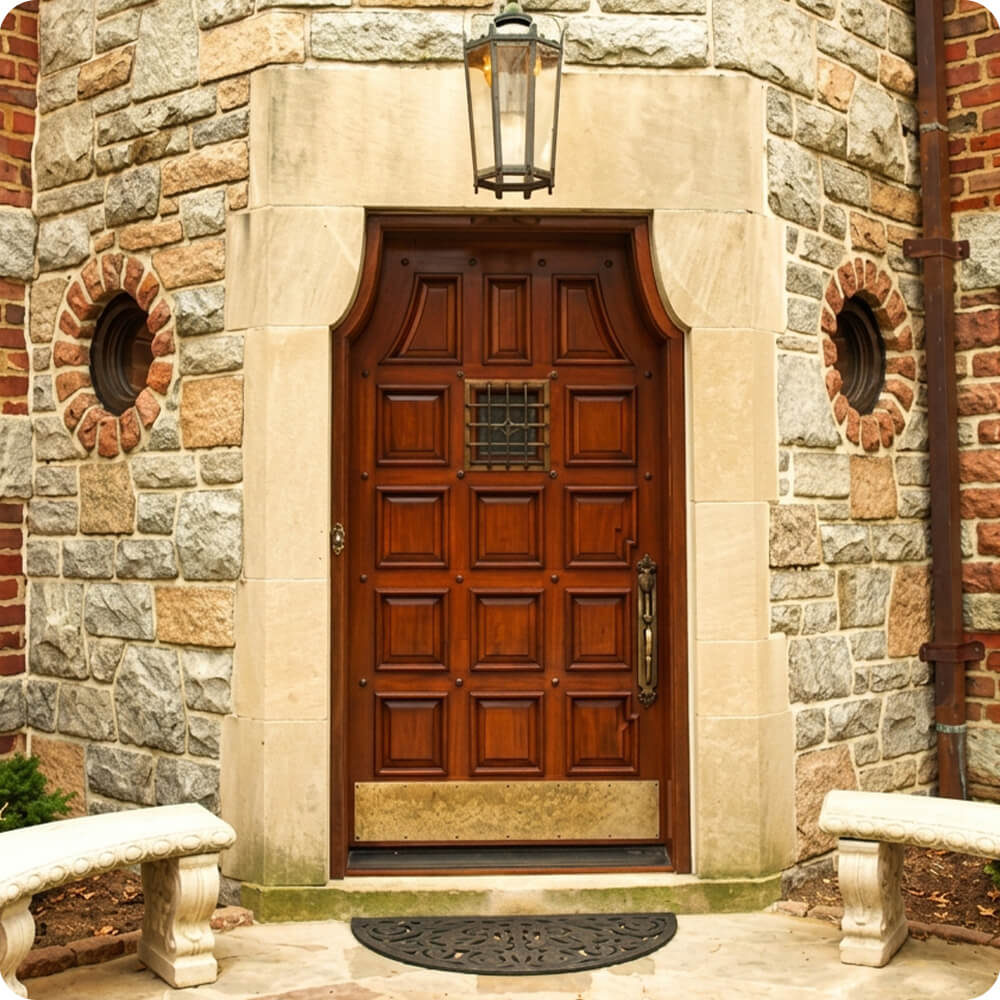
A round stone turret anchors this entry, the kind of architectural detail you don't design around lightly. Twin oculus windows flank the doorway, each ringed in a sunburst of brick, and a wrought lantern hangs overhead like it's been there for a century. The door had to earn its place at the base of that tower, not just fill the opening beneath it.
Project Story
The thinking behind the work
The Starting Point
The Thinking
A door this prominent doesn't need a full window to make a statement, it needs weight and craft you can see from the walkway. The design leans into a twelve-panel raised layout, three panels across and four down, so the door reads as a grid of carved depth rather than one flat slab. In place of a full lite, a small square glass window is set into the upper third of the door, layered with an ornamental wrought-iron grille over the glass — giving the door a genuine glimpse of daylight and a period-appropriate, old-world detail without opening up a large expanse of glass on such a solid design.
The Execution
Built as a solid single door in a twelve-panel raised configuration. A small square glass window sits in the upper third of the door, covered by an ornamental wrought-iron grille — a compact glazed opening rather than a full lite, giving a narrow glimpse outward while keeping the door's solid, fortress-like character intact. Two decorative iron clavos studs punctuate the panel work above and below it.
The Result
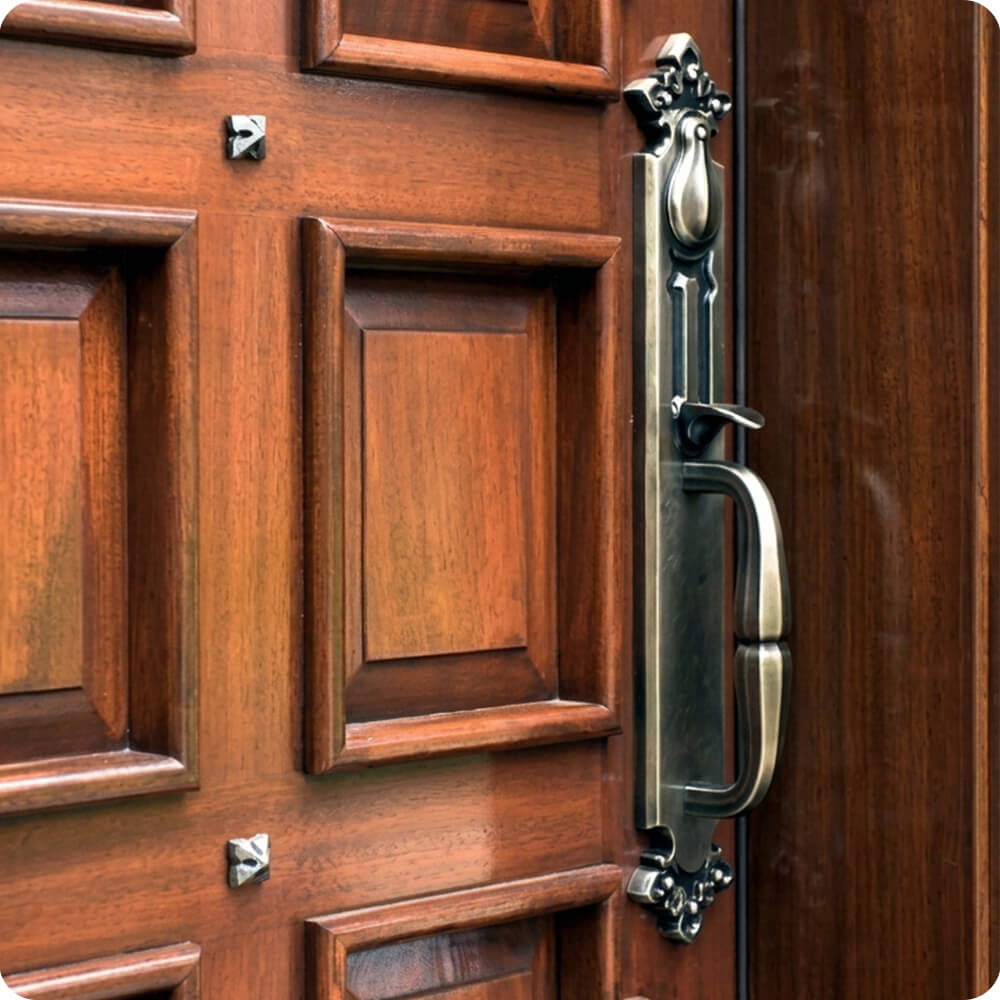
Stand at the base of that turret and the door doesn't compete with the stonework, it completes it. The speakeasy grille and the strap hardware give it the presence of something forged rather than manufactured, and the panel grid catches shadow and light in a way a flat door never could. It's a door built to match a house that clearly wasn't built to blend in.
Specification
Unit Size
4'-0" x 8'-0"
Panel Thickness
1¾"
Joinery
Mortise-and-tenon, no mechanical fasteners.
Glass
Small square glass lite, set behind a decorative wrought-iron grille
Finish System
Marine-grade exterior finish, six sides
Hardware
Full-length antique bronze strap handle with fleur-de-lis finials, thumb-latch mechanism, brass kickplate, decorative iron clavos studs
Installed By
Scobis
Common Questions
Why a speakeasy grille instead of a glass window?
A stone turret entry like this one calls for something with real old-world weight, and a wrought-iron grille does that in a way glass can't, it lets you see who's at the door without opening a pane of clear glass into the design. It's a detail borrowed from centuries-old European entries, built here as a genuinely functional piece rather than decoration.
What's that small window with the iron grille on the door?
It's a small square of glass set into the upper panel, layered with an ornamental wrought-iron grille over it, giving the door a genuine glimpse of daylight and a period detail borrowed from old-world entries, without opening up a large glass area on a door built to feel solid and substantial.
What are those small iron studs on the door panels?
Those are clavos, decorative iron nailheads originally used to reinforce heavy timber doors, now used purely as a design detail that echoes the ironwork in the grille and the lantern above the door. They're a small touch, but they tie the door's metalwork together as one consistent material story.
More Projects Like This