
How to Decide Whether to Restore or Replace Your Wood Door?
Maybe your front door faces west and the afternoon sun has baked the finish until it’s cracking and chalky. Maybe it’s the opposite problem. A shaded, north-facing entry that never quite dries out after a wet Missouri spring, and now the bottom rail feels soft when you press on it. Maybe it’s simpler than either of those. The door just won’t latch right anymore, or there’s a gap at the top you can see daylight through on a sunny day. These are common issues people have so it’s important to understand how to fix them and whether to restore or replace your wood door to avoid spending money where you don’t need to.
Age is a clue, not a rule. A solid wood door built decades ago (say, before the 1970s, just as a rough marker) is often worth restoring, because the wood tends to be denser than what mills produce today, and a door that has survived that many Missouri freeze-thaw cycles has already proven it can hold up. But not every older St. Louis home has a door like that, and plenty of newer homes have solid wood doors worth keeping too.
What actually decides it is the condition of the wood itself. Replacement makes sense when the damage has reached the core structure, not the surface, or when the door was never good stock to begin with.
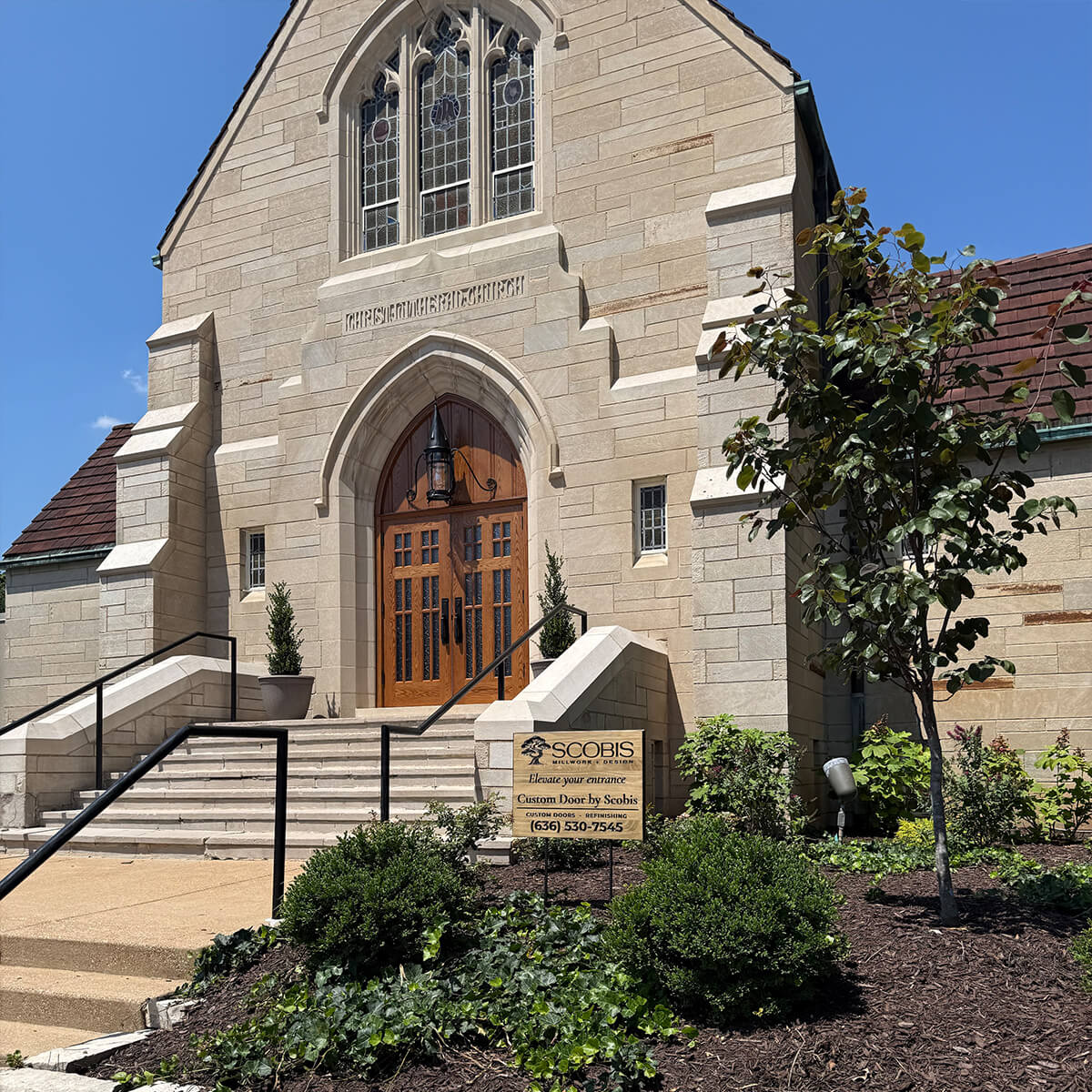
Check the wood, not just the symptoms
A sticking door, a dragging bottom edge, or a gap that lets in a draft are almost never proof that a door is failing. They are proof that a door has moved, and old-growth wood moves with humidity and settling in ways that plywood-core doors from the last few decades do not.
Before you decide anything, do this test: press a screwdriver into the bottom rail, the corners, and anywhere water has clearly pooled or run. Solid wood resists. Rot gives way, feels spongy, or crumbles. That single check separates most “should I replace it” questions into an actual answer.
Signs the door is a restoration candidate:
- The panel and stiles are solid wood, not a veneer over particleboard or a hollow core.
- Sticking, dragging, or drafts appear seasonally rather than getting steadily worse year over year.
- Surface issues (peeling finish, minor dents, faded stain, loose hardware) account for most of what you see.
- Hinges have simply loosened, or the strike plate has shifted with the house settling. That is a carpentry fix, not a door problem.
- The door has a mortise lock, real joinery, or period detailing that a stock replacement will not match, which describes a lot of what’s still standing in Compton Heights, Lafayette Square, and the older blocks of Webster Groves.
Signs the door is a restoration candidate:
- Rot has reached the core of a stile or rail, not just the surface finish.
- The door is warped enough that no amount of planing will get it to seal flat again.
- It is a hollow-core or veneer door to begin with. There is no restoration path for a door that was never solid wood.
- You can see daylight around the frame even after the door is properly hung and weatherstripped, which usually means the frame itself has failed, not just the door.
- The same problem keeps coming back after repairs. That is a sign the underlying frame or foundation issue was never fixed.
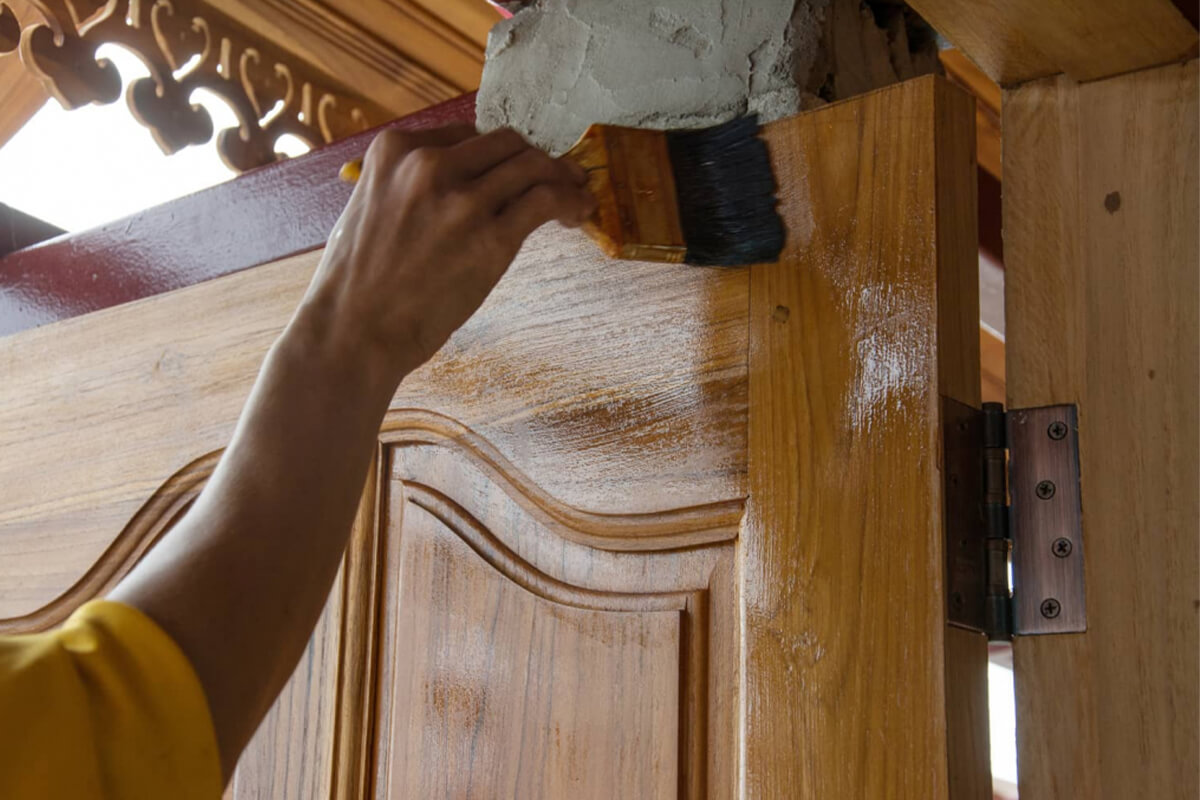
Restoration vs. replacement, side by side
| Factor | Restoration | Replacement |
|---|---|---|
| Typical Cost | $400 to $2,500 depending on scope (refinish only vs. structural repair) | $1,500 to $8,000+ for a custom or period-matched solid wood door |
| Timeline | 1 to 3 weeks for most refinishing and repair work | 8 to 12 weeks for a custom shop-built door |
| Matches Existing Millwork | Yes, by definition | Only if built to match; stock doors rarely do |
| Wood Quality vs. Original | Keeps original old-growth material | New material is almost never as dense |
| Best Fit For | Historic homes, character-grade doors, anything with existing joinery worth preserving | Doors with core rot, doors that were low-grade to start, or homes wanting a design change |
These ranges assume a solid wood or composite exterior door in reasonable starting condition. A church sanctuary door, a hand-carved entry, or a door requiring full frame replacement will land outside this table entirely, which is exactly why a shop should look at it before you commit to either path.
Have a project in mind?
Talk to us about custom doors and millwork for your home, business, or institution.
Why refinishing is often the stronger choice
Refinishing gets treated as the budget option, and the price does reflect that. But the durability argument is often stronger than the cost argument. Wood cut before roughly 1950 came from slower-growing, old-growth stock with tighter grain than what commercial lumber mills produce now. That density is why a well-maintained mahogany or oak door from the early 1900s can outlast three generations of vinyl-clad replacements.
A marine-grade finish applied correctly will hold on an exterior door through decades of Missouri winters, not just a few seasons. We’ve seen this firsthand. A marine-grade finish on a solid mahogany door can still perform after 24 Missouri winters, something no big-box replacement door has a track record to match.
That’s the kind of performance we look for whether the door is on a foursquare in Kirkwood, a bungalow in the Central West End, or a larger entry in Ladue. If your door has already survived this long with only cosmetic damage, refinishing is not a compromise. It is very often the higher-performance option, and it is the only path that keeps the door’s original joinery and hardware intact.
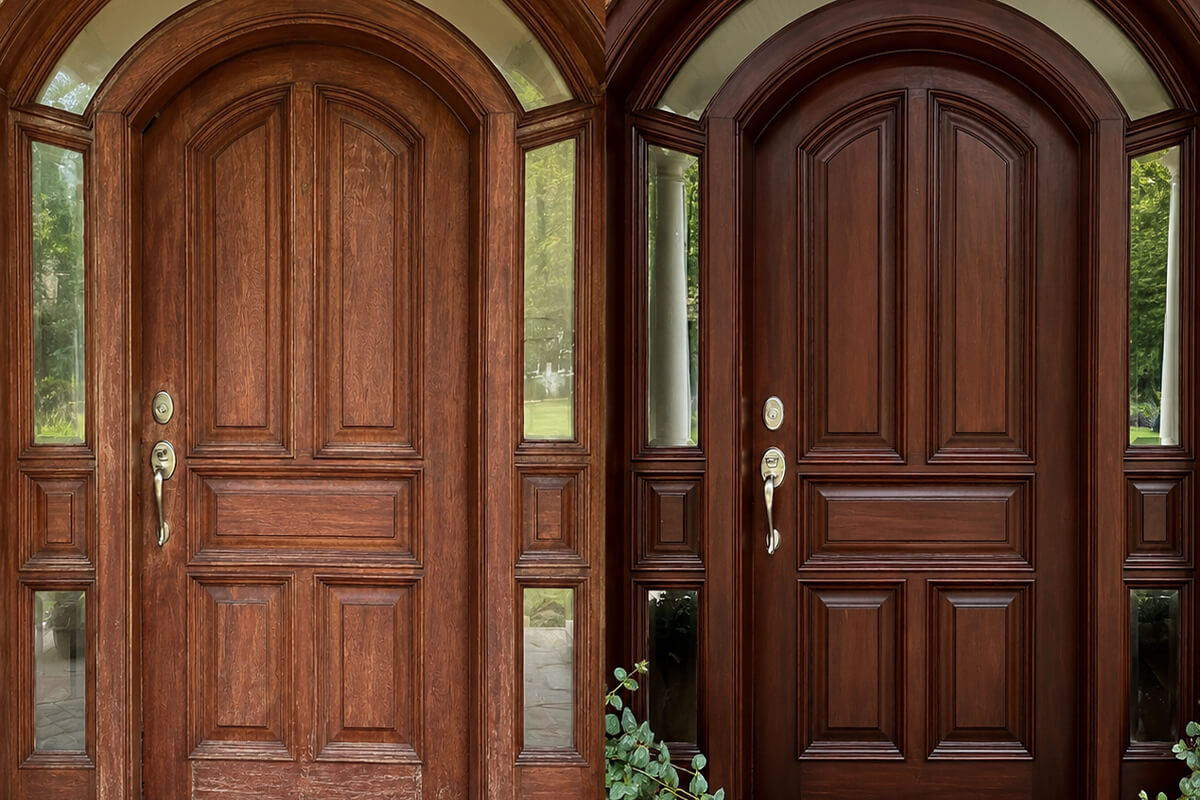
What each refinishing option actually involves
Refinish the door covers a range of jobs, from an afternoon fix to a full shop restoration. Here is what each one actually means, so you know what you’re asking for.
How to stain a wooden door
Staining strips the old finish, sands the wood back to bare grain, and applies new stain and a protective topcoat in the direction of the grain. It’s the right move when the wood itself is sound but the finish has faded, peeled, or gone patchy from UV exposure and Missouri’s swing between humid summers and dry winters. Done correctly, a new stain and marine-grade topcoat can add another decade or more of weather resistance.
How to repair a wooden door
This covers filling dents, cracks, or old screw holes with wood filler, sanding the repair flush, and refinishing over the top for a uniform look. It’s a viable fix as long as the damage is surface-level. Once wood filler starts covering soft or crumbling wood rather than a clean crack, that’s a sign the repair has become a stopgap rather than a fix, and it’s worth having a shop check the wood underneath.
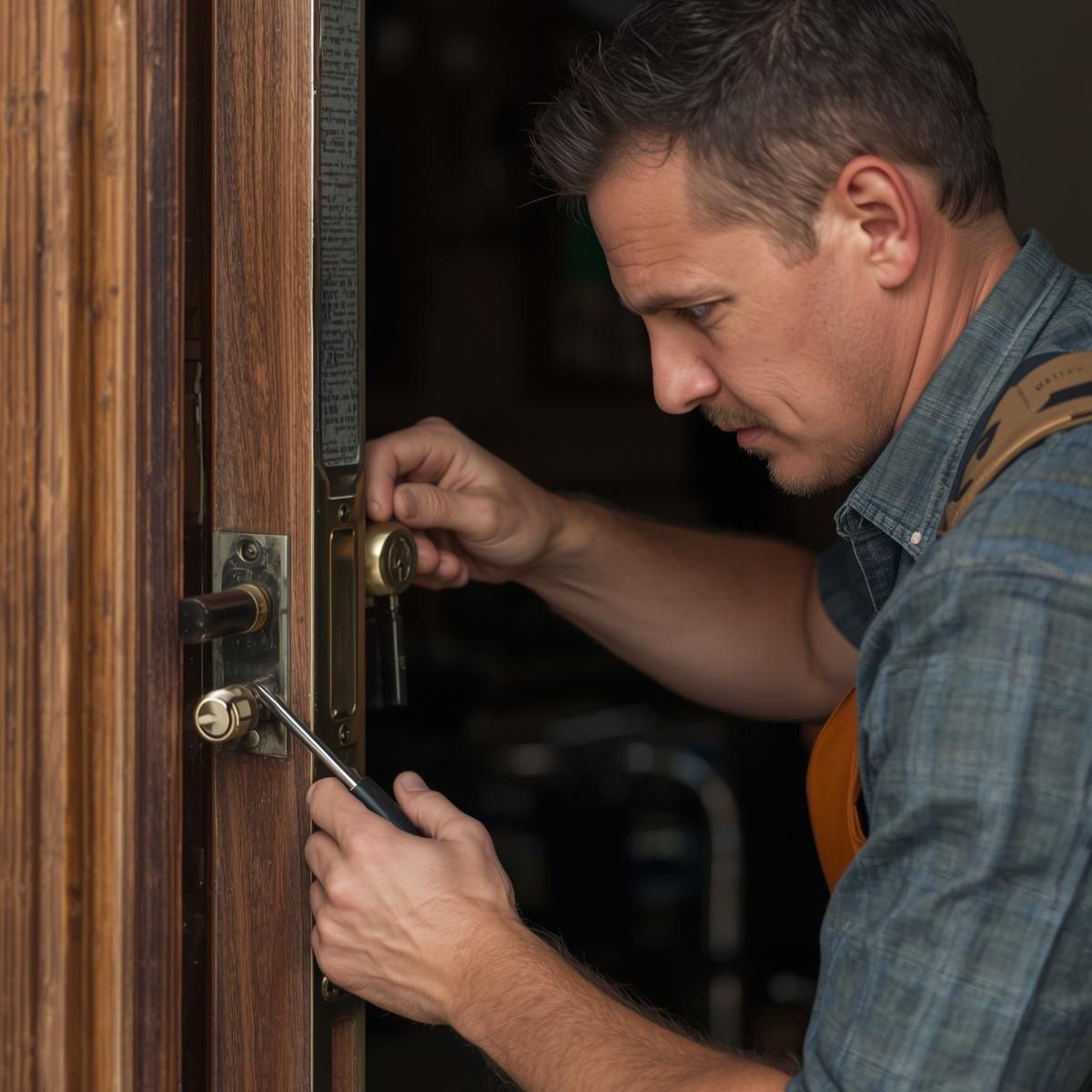
How to replace a door hinge
A worn or bent hinge is one of the most common reasons a solid door starts sagging or dragging, and it has nothing to do with the door itself. Hinges are removed, the frame and door are marked to preserve alignment, and new hinges are set into the existing mortises. On a period door, matching the hinge finish and style matters for keeping the hardware consistent with the rest of the house.
How to fix door handles
Loose or sagging handles are usually a spindle, screw hole, or spring problem, not a sign the door is failing. Worn screw holes get filled and re-drilled, and depleted internal springs typically mean replacing the handle mechanism itself while keeping the original backplate or escutcheon if it’s a good match for the door’s era.
None of these fixes require touching the door’s structure, which is exactly why they belong in the restoration column rather than the replacement one. If any of them keeps coming back after being addressed, that’s the signal to stop treating the symptom and get the door properly assessed.
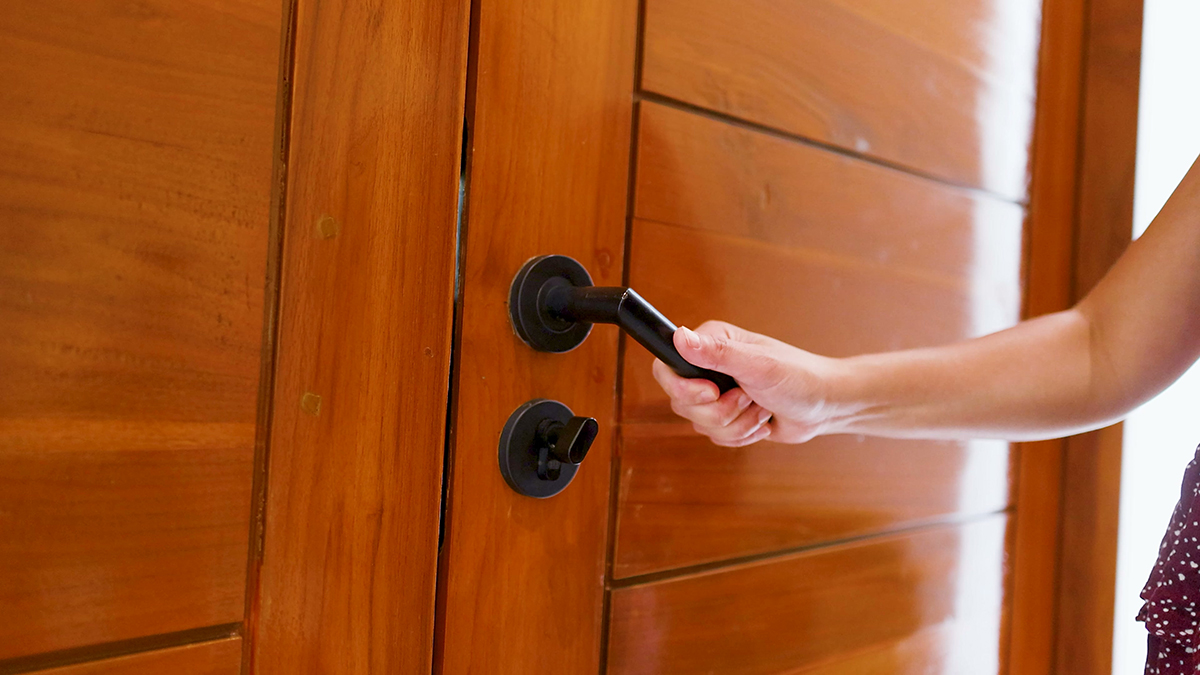
When to buy a new custom door
Restoration is not always the right call, and a shop that tells you otherwise on every door is not being straight with you. A new custom door is the better investment when:
- The door was mass-produced, hollow-core, or built from low-grade material with nothing worth preserving.
- Structural rot has reached the frame, not just the door slab.
- You are changing the opening’s size, configuration, or glazing, which a restoration cannot do.
- The cost of repeated repairs on a failing door has already exceeded what a new, correctly built door would cost.
In those cases, a custom-built replacement that matches your home’s existing millwork profile, down to the panel proportions and glazing pattern, will outperform a stock door from a home center, and it will not look out of place next to original trim, whether that’s a historic entry in Frontenac or a newer build in Chesterfield.
When to restore your door and when to replace it
The honest answer to “restore or replace” depends on the door in front of you, not on which service is easier to sell. That’s why Scobis Millwork + Design runs both sides of this decision under one roof: a refinishing and restoration team that can bring a century-old St. Louis door back to full performance, and an architectural woodshop that builds custom, period-correct replacement doors when a door is genuinely past saving.
If you’re not sure which side of that line your door falls on, that’s exactly the kind of question worth an on-site assessment rather than a guess. Whether you’re in Lafayette Square, Clayton, Kirkwood, or anywhere else in the St. Louis area, we’ll tell you plainly whether your door is worth saving, and either restore it or build the replacement it deserves.
FAQs: Restore or replace your wood door
Is it cheaper to restore or replace a wood door?
Restoration is almost always cheaper up front, typically a third to half the cost of a custom replacement. Replacement becomes the better value only when a door needs repeated repairs or the core structure has failed.
How do I know if my door frame has rot?
Press a screwdriver into the wood at the bottom corners and anywhere water collects. If it sinks in easily or the wood feels soft and spongy, the frame has rot and likely needs repair or replacement, not just the door.
Can a shop match an old door's hardware and joinery?
Yes. An architectural woodshop working from the original mortise locations and joinery can replicate them in a replacement door, or restore the originals if the wood underneath the hardware is still sound.
Will restoring my door actually hold up in Missouri weather?
It will, if the finish system is applied correctly. A marine-grade exterior finish on solid wood is built for repeated freeze-thaw cycles and humidity swings, which is exactly what St. Louis winters and summers put a door through.
Do I need to replace the whole frame if I replace the door?
Not necessarily. If the existing frame is still square, level, and free of rot, a new door can often be fit to it. If the frame has shifted or rotted, replacing just the door will not fix the underlying problem.
Contact Our Team!