Who Restores Historic Wood Doors in St. Louis?
If you own an older home in St. Louis, your front door may be the hardest-working antique you have. When it starts to stick, peel or let daylight through, the first question is who to call: a refinisher, a restoration specialist or a millwork shop?
The honest answer depends on what is actually wrong with the door. At Scobis Millwork we have restored and rebuilt doors and woodwork for St. Louis homes since 2001. Here is how we help homeowners decide, including when a millwork shop is more than they need.
Who restores historic wood doors in St. Louis?
Three kinds of businesses do this work, and each one solves a different problem.
- Refinishers and stripping specialists renew the surface.
- They remove failed paint or varnish and apply a new finish to a door that is structurally sound.
- Restoration specialists focus on preserving original material, and many combine careful stripping with minor repairs.
- Millwork shops can do surface work too, but they can also rebuild what is broken: panels, moldings, joinery, arched tops and whole doors made to match the original.
Many homeowners assume a millwork shop only builds new doors. At Scobis, restoration comes first. We replicate only what is missing or too far gone to work again.
Should I hire a refinisher or a millwork shop for my old house?
The real difference is surface versus structure.
If the door closes well, the joints are tight and the wood is solid, but the finish is cracked or peeling, a good refinisher is the right call. That is the same work we do at our lighter restoration levels, and we will tell you so if that is all your door needs.
Once the problem goes deeper than the finish, you need a shop that can make parts. Signs you have crossed that line include:
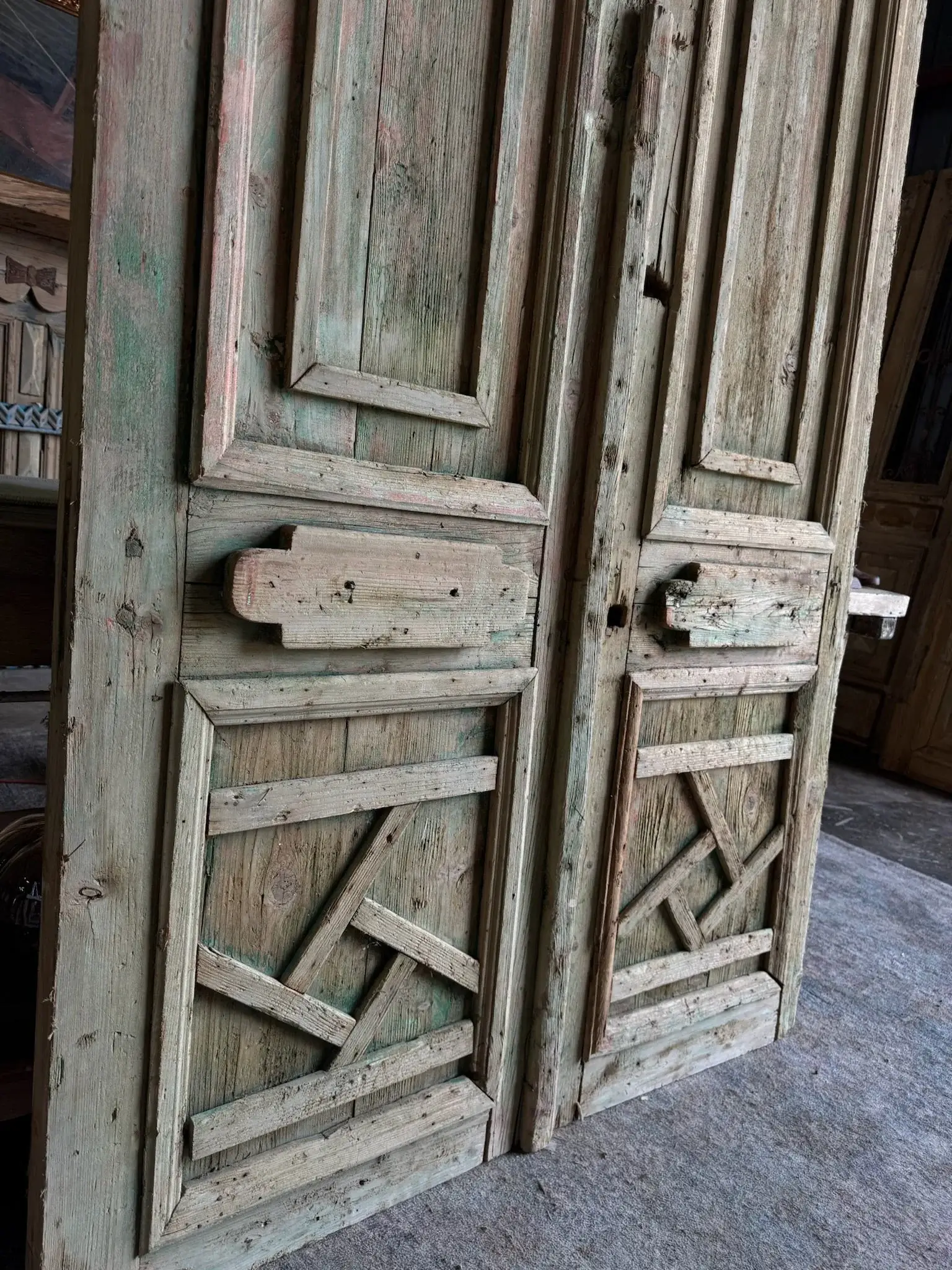
- A panel that is cracked, split or rotted through
- Joints that have loosened so the door sags or racks
- A door that no longer fits the opening or closes properly
- Missing pieces of an arched top, transom or sidelite
A refinisher can make a door look better. A millwork shop can make it work again, then make it look right.
Looking for a custom wood door?
Send your specifications, images and your project, and our experts will guide you through the process.
How do you decide whether to restore or replace a historic door?
The deciding question is whether the door has enough sound structure for a repair that will last. Jim, who assesses our restoration projects, looks at three things on every door: its physical condition, the existing finish, and the hours it will realistically take to bring it back.
What are the levels of door restoration?
What are the levels of door restoration?
We sort restoration work into three levels so homeowners know what they are paying for.
- Level 1, maintenance refresh. For a sound door with a tired finish.
- Level 2, partial strip. The finish is partly removed and the door stays its current color or goes slightly darker.
- Level 3, premium restoration. The door comes off its hinges and goes to our shop for a full strip and repairs.
Can you repair part of a door instead of replacing it?
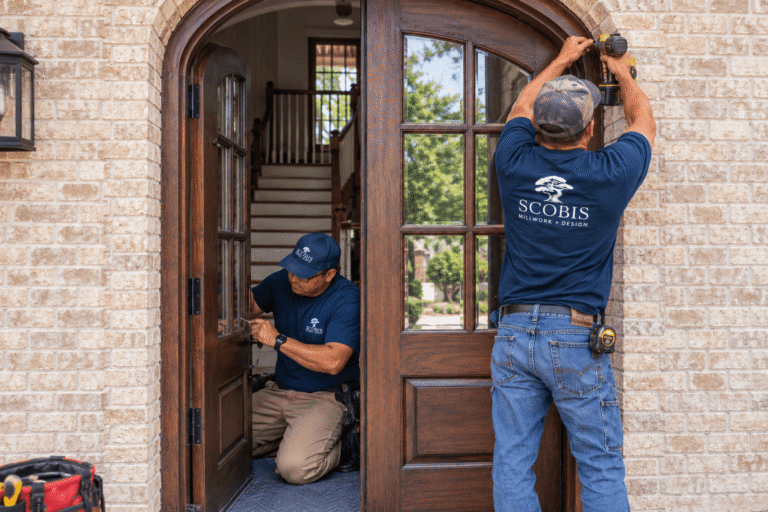
Yes, and this is where a millwork shop earns its keep. On a recent arched entry door in Kirkwood, one panel was too damaged to save. We rebuilt that panel and its molding in the shop, then kept and refinished the rest of the original door inside and out. The homeowner kept their original door, with one new piece made to match it.
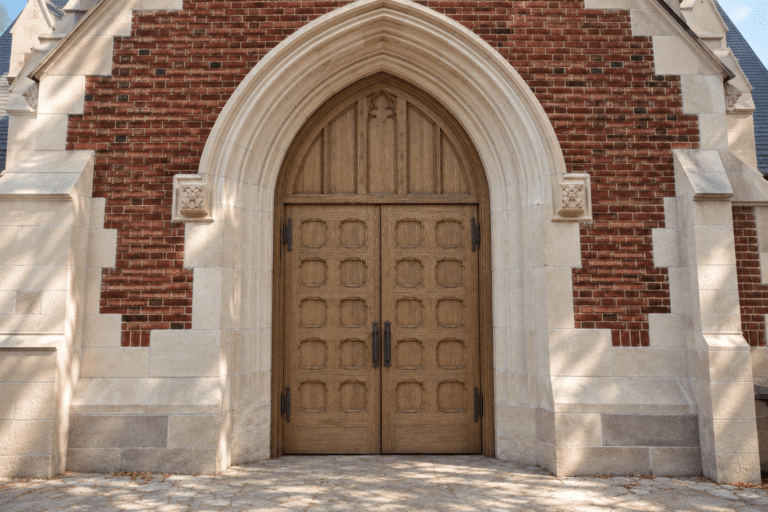
The same thinking applies at a larger scale. When we built three pairs of red oak doors for St. Mary’s Catholic Church in Alton, Illinois, a building from 1895, the doors themselves had to be replaced, but the original stained-glass tracery transoms above them stayed in place.
What can stop a restoration?
Two things change the plan more than anything else.
Lead paint is the first. Homes built before 1978 are tested before we start. If lead is found, work stops, because Scobis does not work on lead paint.
Veneer is the second. Some doors that look like solid wood are veneered, and veneer can only be stripped so far. On a pair of arched double doors in Des Peres, the doors turned out to be more weathered than expected once work began, and they were veneered. The plan changed from taking them lighter to an even match of their current color, finished with three premium top coats.
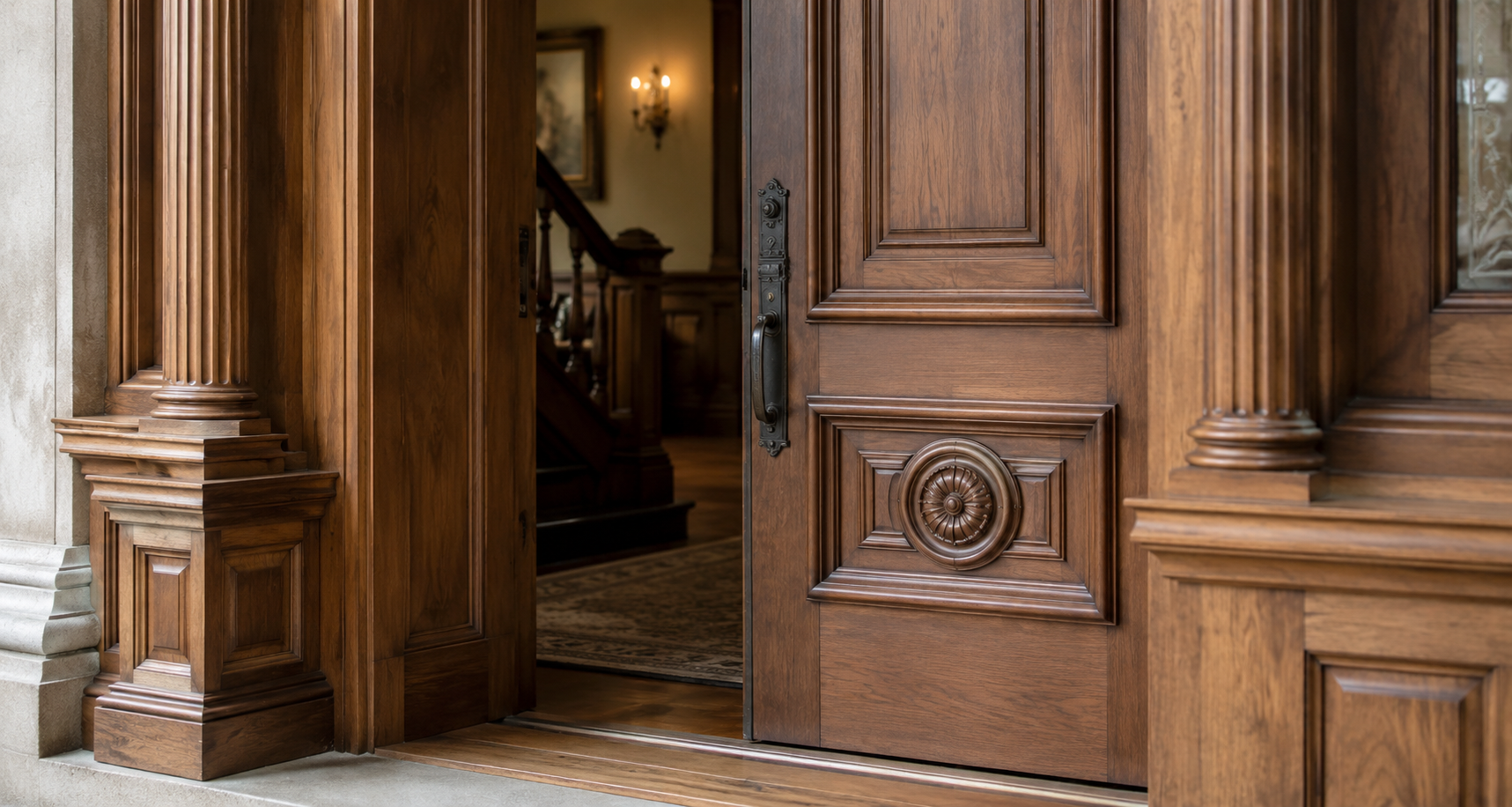
What makes historic door restoration in St. Louis different?
Do I need approval to restore a door in a historic district?
Often, yes. Lafayette Square, Soulard, the Central West End and Compton Hill are local historic districts, each with its own standards, and exterior work there is reviewed by the City’s Cultural Resources Office. In the Central West End, work done without prior approval can lead to a Stop Work Order, and work that doesn’t meet the standards may have to be undone.
The good news is that the process is approachable. The Cultural Resources Office offers a free preliminary review, typically answered within three business days, and a walk-up Hotspot Desk at City Hall for questions about doors.
How does the Missouri climate affect wood doors?
St. Louis wood moves. Humid summers and dry winters make doors swell and shrink, which cracks rigid finishes. That is why we use exterior-grade paint on every surface that faces the weather, including the inside face of an exterior door. Exterior coatings flex with the wood instead of splitting.
Weather also sets the schedule. Rain can stop exterior work, and December can be too cold for finishes to cure properly, so some late-year projects roll into spring.
The doors we see most in St. Louis homes are arched entries, double doors, and doors with sidelites and transoms, each with more joints and glass that need attention.
Looking for a custom wood door?
Send your specifications, images and your project, and our experts will guide you through the process.
How much does historic door restoration cost?
We don’t publish flat prices, because two doors that look alike can need very different work. Every job is quoted once we understand the condition and scope. These are the factors that move the number:
- The restoration level, and whether the work can be done on site or needs the shop
- One side of the door or both
- How many pieces are involved: single or double doors, sidelites, transoms, arches, jamb and trim
- Rebuilt panels, moldings or unusual profiles
- Veneer, or a request to go much lighter, which requires a full strip
- Glass, hardware, hinges, weatherstripping and fit corrections
- Historic approvals, travel distance and installation logistics
- Hidden damage found once the old finish comes off, since final billing reflects actual hours
FAQs: Historic Wood Doors Restoration
How long does it take to restore a historic wood door?
Usually a few days of work. Scheduling depends on the season and weather.
Will my house be without a front door during restoration?
Not for on-site work, where the door stays in place. When a door goes to our shop for a Level 3 restoration, the opening is securely boarded up until the door is reinstalled.
Can a veneered door be restored?
Yes, but with limits. Veneer can’t be stripped as deeply as solid wood, so large color changes are usually off the table.
Does Scobis restore doors or only build new ones?
Both. We assess every door for restoration first, repair and refinish what is sound, and replicate only what can’t be saved. You can see the full scope of our historic door restoration in St. Louis on our preservation and replication page.
Which St. Louis areas does Scobis serve?
We work on historic homes across St. Louis City and County, including the Central West End, Lafayette Square, Soulard, Kirkwood, Webster Groves, Clayton and Ladue.
Contact Our Team!
More articles like this
A Millwork Shop’s Guide to St. Louis Doors by Neighborhood
Read article →
How to Match Wood Doors in a Historic Renovation
Read article →